
Baking the Libum: An Experiment in Ancient Roman Cooking
Introduction
As part of the Experimental Archaeology course at Sapienza University, Federica, Leonardo and I decided to reproduce a recipe from ancient Rome: the libum, a ricotta bread mentioned by Cato in De agri cultura. Ancient sources link the libum to sacred ceremonies in honor of Liber Pater, a Roman god sometimes identified with Jupiter: it seems that it was originally made by the priestesses of the god and offered as a sacrifice during the Liberalia festival. From the late Republic onwards, the name of this flatbread was used as a generic term for different types of cake.
Experimental activity
The procedure reported by Cato to prepare the libum is as follows: “Do this: chop 2 pounds of sheep’s cheese in a mortar; after chopping it well, add a pound of flour, or half a pound if you want it to be softer, and mix. Add an egg and mix well. Then shape the bread; place a few bay leaves under it; cook it slowly over a hot fire, covering it with a lid...”
We did not have an oven available, so we chose to use an ancient method called cottura sub testu. This involved placing a baking tray directly on the embers, with a lid on top, in order to maintain a more even and controlled cooking environment, much like in an oven. This method was mainly used in family and rural settings by those who did not have access to an oven for economic or geographical reasons. We also sought the help of an experimental archaeologist who had previously replicated the recipe using modern tools (modern cookware, an electric oven, etc.).
However, in order to reproduce the recipe as closely as possible to how it was made in ancient Rome, we decided to make a mortarium, a testum, and a clibanus out of ceramic, replicating ancient objects as closely as possible. For the testum and clibanus, we chose to imitate the containers found in the Spoletino cistern (Civitella d’Agliano, VT), a large rainwater collection system probably belonging to a villa; the baking tray and lid we made are inspired by shapes from the 1st century AD. For the mortar, on the other hand, we studied one from Salla, in Roman Pannonia.
We took precise measurements of our ancient models in order to reproduce them to scale, and we tried to recreate a similar fabric, as indicated in the studies. For the mortar, for example, the mixture required a percentage of grog (already fired and crushed ceramic), which was useful for giving the container a structure more resistant to thermal and mechanical shock and for creating a rough surface inside. The testum and clibanus, on the other hand, required purified clay, which we carefully worked to prevent air bubbles from remaining in the mixture and causing damage to the vessels in the kiln (the risk is that they burst!).
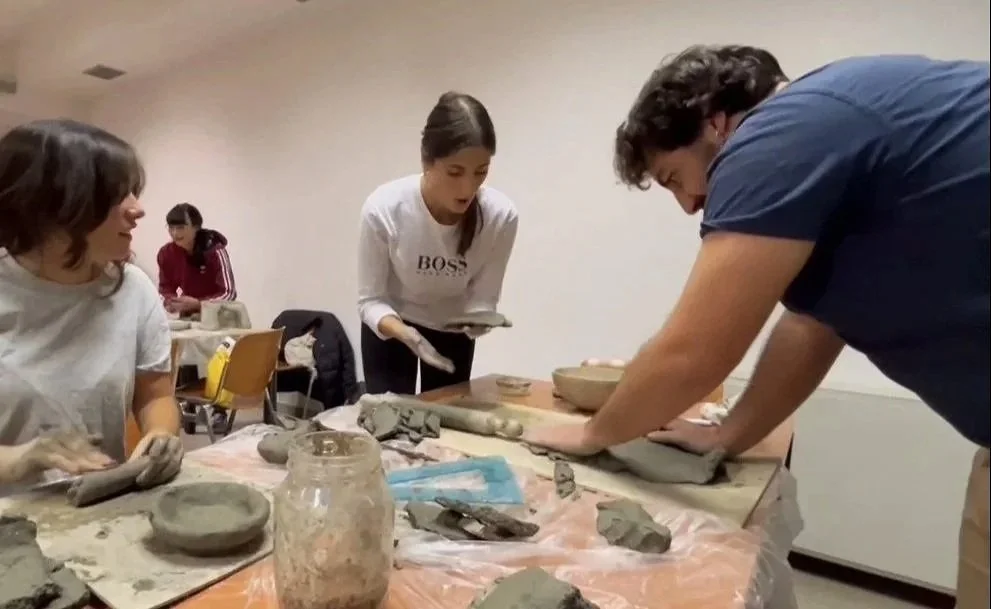
We used the coiling technique for shaping, and the process went quite smoothly, despite the difficulty we encountered in pulling up the mortar walls and making the surface rough enough to ensure that the grog would adhere well to the mixture, so that no ceramic fragments would come off during use. Once the vessels were shaped, we weighed them and took their measurements to compare them with those taken after firing. The trip to the kiln—the step we feared most—went quite well: once we took them out, we measured them again and found that they had retained the desired dimensions, shrinking by a few millimeters. However, with the evaporation of the moisture in the mixture, circular cracks had formed at the junction between the base and the wall.
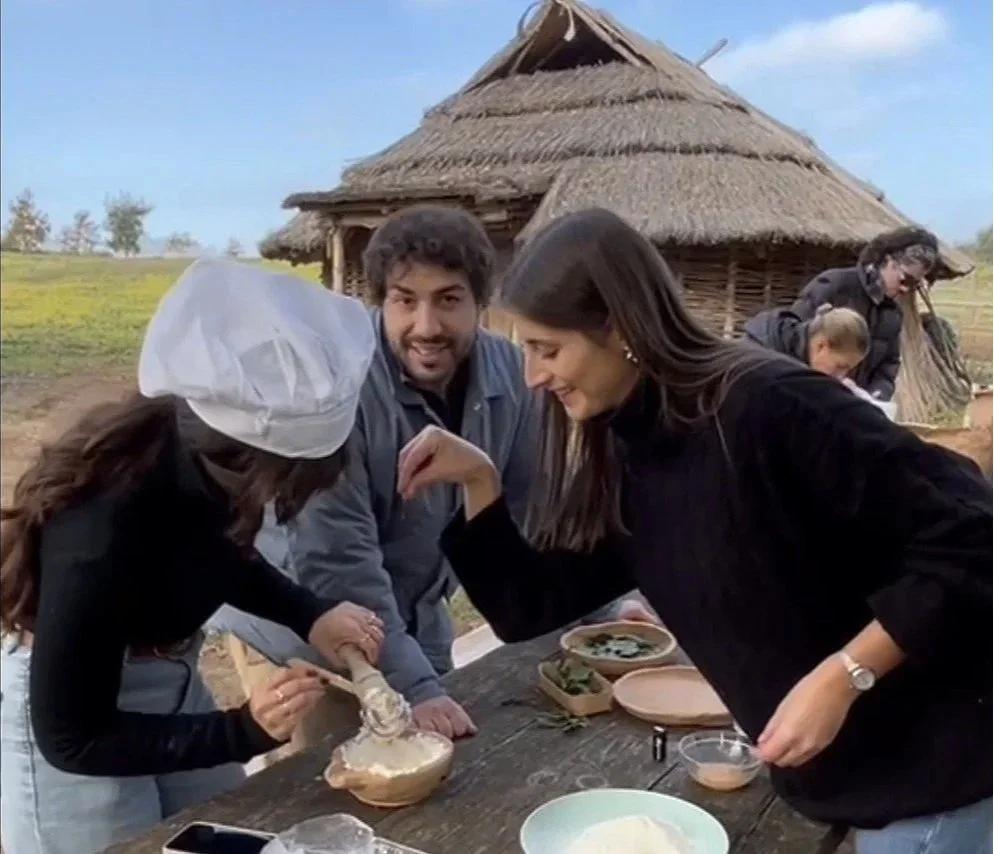
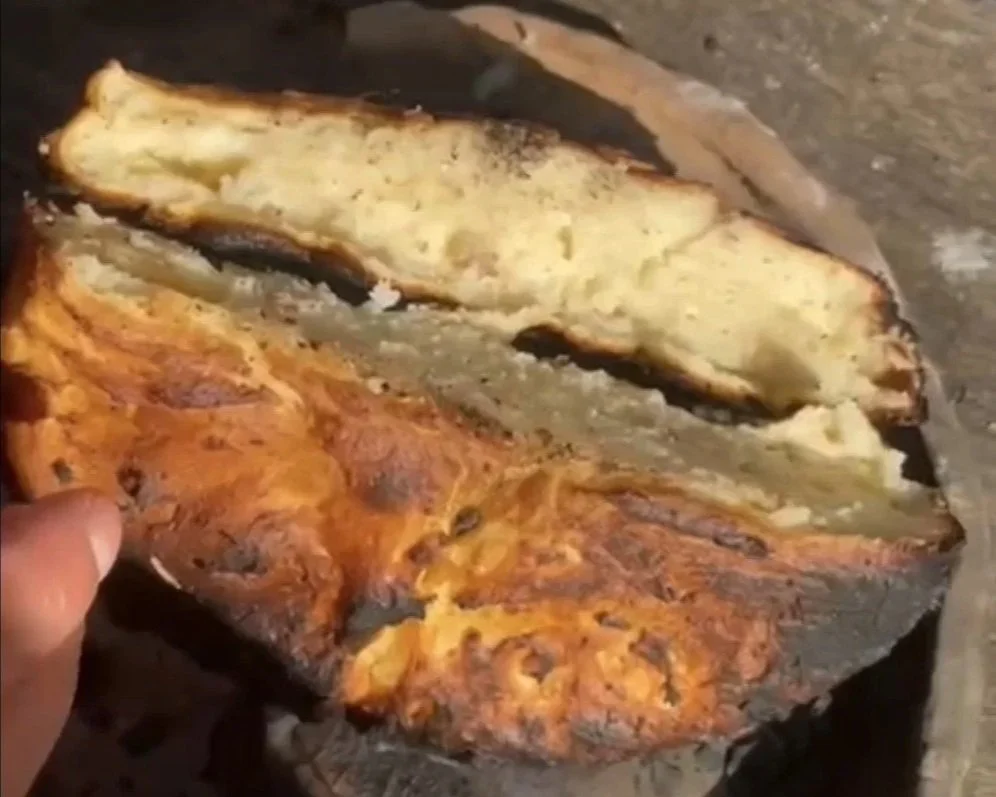
Once the vessels were ready, we began the recipe: we mixed the ingredients in a mortar, covered the bottom of the testum with bay leaves (the cracks did not cause any problems!) and transferred the dough inside. We drew a cross on the bread, as in ancient times, covered it with the clibanus and placed everything on the embers, spreading some embers on top of the lid as well. About 20 minutes later, our libum was ready! Although it was slightly burnt (it was difficult to control the heat of the embers), it had a delicious scent of bay leaves and, when we cut it to let our colleagues taste it, it made the sound of a freshly baked crust… our mouths were watering.
Conclusions
Once we tasted it, we felt truly satisfied with our work: first we put our hands in the clay, then in the dough; we breathed in the smell of bay leaves mixed with smoke; we listened to the crackling of the embers during cooking, immersed in the green countryside—a truly authentic experience.
Our vessels withstood direct contact with the fire and actually became even more beautiful after use, enriched with shades of soot on the bottom and lower part of the walls, typical of archaeological examples of ceramic cooking pots. Even the inside bottom blackened slightly, like the bay leaves—but in return we achieved a very good crust.
Bibliography and webography
Cubberley, A. L., Lloyd, J. A., & Roberts, P. C. (1988). Testa and clibani: The baking covers of classical Italy. Papers of the British School at Rome, 56, 98–119.
Elefante, M. (2023). Sub testu baking in Roman times: Testa and clibani from the Tiber Valley. The case of Spoletino (Civitella d’Agliano, VT). Rei Cretariae Romanae Fautorum Acta, 47, 75–82.
Frayn, J. (1978). Home baking in Roman Italy. Antiquity, 52, 28–33.
Furger, A. R. (1985). Eating and drinking in Roman Augst: cooking, eating and drinking as reflected in some finds. arCHaeo, 1985(8).
Gasperni, T. (2003). The Domitii kilns: Topographical research in Mugnano in Teverina. Viterbo.
Glinister, F. (2014). Festus and ritual foods. Eruditio Antiqua, 6, 215–227.
Ozanic Roguljic, I., & Raickovic Savićùc, A. (2020). Sub testu: Preparation of Roman food under a clay dome. Vjesnik Arheoloshkog Muzeja u Zagrebu, 53, 85–91.
Pallecchi, S. (2002). Mortars produced in central Italy: Corpus of stamps (Instrumentum I). Rome.
Tigrane, E. (2012). The cuisine of the ancients: Experiences and methods in the preparation of some Roman culinary recipes. In A. C. Sparavigna (Ed.), Cooking the volumes. Archaeogate.
Varga, G. (2010). Roman mortars from Salla. Acta Archaeologica, 61(1), 145–184.
Whitehouse, D. B. (1978). Home baking in Roman Italy: A footnote. Antiquity, 52, 146–147.
https://www.engramma.it/eOS/index.php?id_articolo=4044&utmFurger. 1985 =
Cover image: Fresco from the House of Casa di Giulia Felice, Pompei, preserved at the Museo Archeologico Nazionale di Napoli. Photograph by Wolfgang Rieger, Wikimedia Commons (public domain)