
Following the Benedictine Rule: cooking at San Vincenzo al Volturno Abbey in the IXth century
INTRODUCTION
Being a Benedictine monk in the Middle Ages implied some rigid rules when it came to your lifestyle, but not all of them were followed with the same integrity, and some monks did not follow them at all. One of the strictest rules was the regulation of meals, stated in chapter 39 of the Benedictine Rule, "On the Measure of Food", which listed the dishes the monks were allowed to have daily during the different times of the year and according to their health.
"We think it sufficient for the daily dinner [...] that every table have two cooked dishes on account of individual infirmities. [...] And if any fruit or fresh vegetables are available, let a third dish be added. Let a good pound weight of bread suffice for the day [...]. Above all things, however, over-indulgence must be avoided and a monk must never be overtaken by indigestion [...] and frugality shall be observed in all circumstances. Except the sick who are very weak, let all abstain entirely from eating the flesh of four-footed animals."
CONTEXT
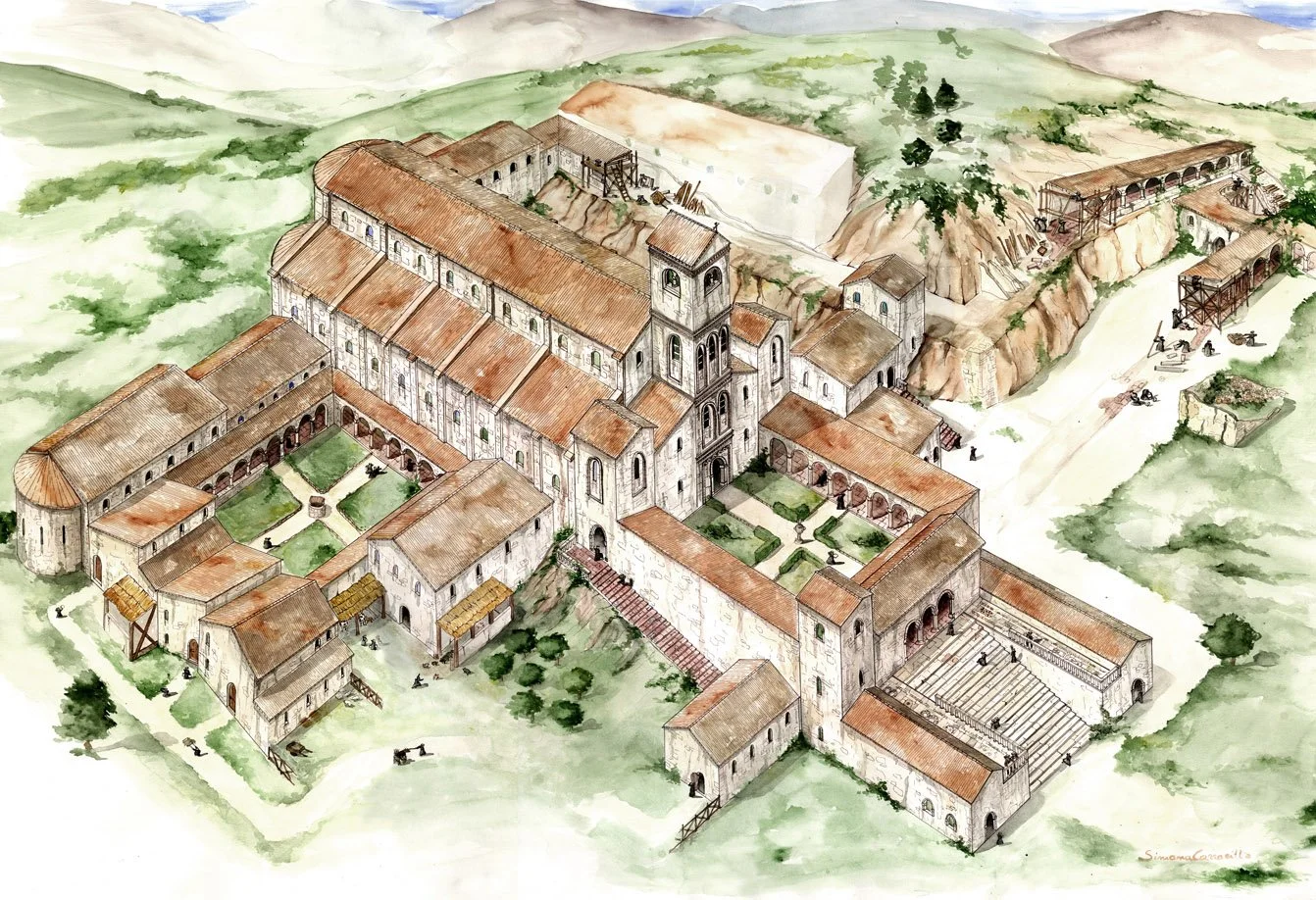
With this in mind, it is even more interesting to analyse data from the excavations in San Vincenzo al Volturno Abbey in Molise (Italy), a complex of buildings built from V-VIth century A.D. on the shores of the river Volturno. This site is an important source of information for the daily life of the monks, since it was set on fire on the 10th of October 881 A.D., sealing it for more than a millennium and giving us access to rooms like the kitchen and the refectory completely untouched. More importantly for this research, this monastery had a very peculiar structure that allowed the monks to toss food waste directly from the kitchen into the river Volturno, a small channel made with tiles that, when found, was full of bioarchaeological residue. The analysis of these materials, mostly animal bones, gave us an insight on the monks' diet and confirms that they did, indeed, follow the Benedictine Rule quite strictly: most remains were of bird and fish bones, with a great percentage of fish coming from the river close by. Some of the remains also showed some signs of cutting and burning, which allowed for a reconstructive hypothesis of the cooking process: fish were beheaded and cut horizontally to get smaller portions, and the bones do not have direct traces of burning, which means that they were probably cooked in a pot and not roasted.
Having taken this into account, the ceramic type that seemed most fitting for this project is the pot. Among the remains found in the kitchen of the Abbey and the different ceramic types, this is the most widespread: since its dimensions are exiguous, a big quantity of pots was needed to cook for the whole monk community, and this explains why so many were found on site. In this monastery, in the IXth century, this kind of pot rarely had handles because it was meant to be hung over the fire to cook or used reverbatory cooking.
EXPERIMENTAL ACTIVITY
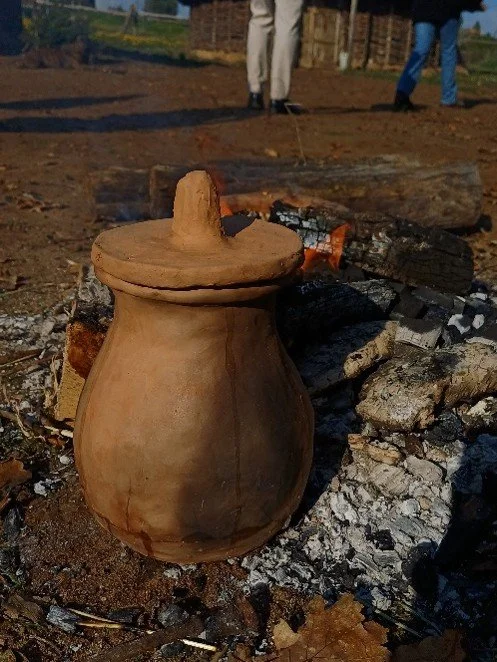
To recreate a plausible Benedictine recipe from San Vincenzo al Volturno, I tried an experimentation to test a hypothesis on the use of pots in the kitchen. After researching thoroughly both the context and the artefact. I started with the production of the pot, using clay mixed with a small part of sand to make it more suited for cooking. To shape the pot I used the coil method, a technique where clay is rolled into strings (called coils) that are stacked and joined together. In the Middle Ages, the preferred technique was the pottery wheel, which requires a long training that would have been incompatible with the time available to complete this project. To complete the pot I also decided to add a lid. After drying and firing, neither the pot nor the lid showed any damage to their structure.
When it came to the recipe, I chose to make a fish soup and I tried to make it as simple as possible, without adding condiments, to keep faith to the Benedictine Rule that the monks followed. First, I removed the fish head, then I cut it into horizontal slices, and then I put it in the pot with some water. To cook it I put it close to the embers, with no direct contact to the fire. To reach the boiling point it took around 20 minutes, and to fully cook the soup it took one hour and a half. During the cooking process, the pot started to show some damage on the sides and at the bottom, with some small cracks that leaked some soup. The damage, however, was very limited and did not interfere with the cooking.
CONCLUSIONS
We can finally understand that the damage on the pot is probably due to the different technique used to make it and the fact that it was not made by an expert ceramist. The burning signs on the pot were consistent with those found on the archaeological pots. The dimensions of the pot I recreated were the same as the archaeological pots: based on this, we can assume that the monks needed a great quantity of pots to cook for everyone, since they were very small and could hold about one fish each. As of the recipe, this reconstructive hypothesis of the pot checks out with the fact that it was used to boil the fish, since boiling was quite fast, given its dimensions. The recipe I tried follows the precepts that the monks had to live accordingly to, since it is as simple as possible, and uses a local and easily available product like fish.
BIBLIOGRAPHY
-Marazzi F., Luciano A., Iuxta flumen vulturnum. Gli scavi lungo il fronte fluviale di San Vincenzo al Volturno, 2015.
-Carannante A., Chilardi S., Solinas F., Last Meal for the Monks. Human Ecology, Food Prescriptions and Manipulation from a Sealed Archaeological Context. Case Study of San Vincenzo al Volturno Abbey, Molise, Southern Italy, Late Ninth Century ad. Cambridge Archaeological Journal, 2022.
-Carannante, A. et al., Le cucine di San Vincenzo al Volturno. Ricostruzione funzionale in base ai dati topografici, strutturali, bioarcheologici e chimici, 2008.
-San Benedetto, Regola.