
Spelt Bread in Pre-Roman Italy: An Archaeological Experiment
Spelt is one of the oldest cereals cultivated on the Italian peninsula and represents a fundamental resource in the diet of pre-Roman Italian communities. Archaeological and literary sources attest to the widespread use of this cereal, not only as a daily foodstuff but also as a culturally significant product.
The experiment presented here arises from the encounter between archaeological data, historical sources, and reconstructive practice. The starting point is a passage from Pliny the Elder's Naturalis Historia (Plin. Nat. Hist. XVIII, 106), which describes a spelt-based bread produced in Picenum and enriched with grape juice: "Picenum still retains its reputation for the invention of alica bread. After soaking it for nine days, on the tenth they knead it with grape juice, and make a sheet of it; then they bake it in an oven inside vessels that break in the fire. It can only be eaten soaked, generally in milk and honey." The widespread and intensive use of this cereal is confirmed by numerous archaeobotanical records of spelt, extensively documented also by recent studies, such as that of Alessandra Cohen from 2021[1].
The experimental recipe uses ingredients plausible for the period: whole spelt flour, soaked and blended spelt, raisins, grape juice, passito wine, oil, and salt. Everything was combined together to form a kind of flatbread approximately 1.5 cm thick.
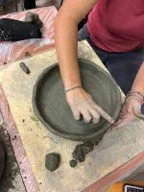
Particular attention was also devoted to the cooking vessel: a tongue-handled ceramic baking tray made using the coil technique, to whose clay body sand was added, modelled on the type found at the excavation of Pianara (Fondi, LT) by the University of Pavia. This is a form widely attested in Italy from the protohistoric period through to the medieval age[2].
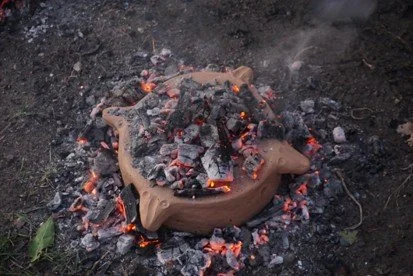
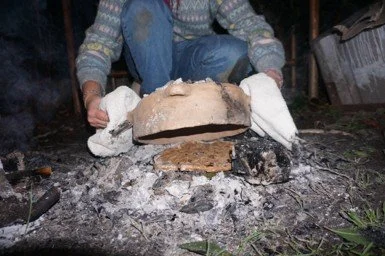
The sub testu method of cooking was employed: the tray was used upside down and covered with burning embers, functioning as a true "small oven." The bread, cooked on a bed of bay leaves, achieved good baking also thanks to a vent hole that allowed moisture to escape.
The final result was a fully edible bread, consumed with milk and honey, which demonstrates how archaeological experimentation can offer valuable information on the food practices of the past, integrating material data and written sources.
BIBLIOGRAPHY
[1] A. Coen, Il consumo del farro e dei cereali in ambiente etrusco-italico e nel Piceno in età preromana, in StUrbin 87, 2021, pp. 87–107.
[2] For these types of baking tray, see: M. Elefante, La cottura sub testu ai tempi dei romani: testa e clibani dalla valle del Tevere. Il caso di Spoletino (Civitella d'Agliano - VT), in ReiCretActa 47, 2023, pp. 75-82. For protohistoric forms and their distribution: S. Solano - E. Basso - M.P. Riccardi, Studio archeologico e petro-archeometrico delle teglie con presa a linguetta (Lappenbecken) nell'arco alpino centro-orientale, in S. Menchelli - S. Santoro - M. Pasquinucci - G. Guiducci (eds.), Late Roman Coarse Wares, Cooking Wares and Amphorae in the Mediterranean, BAR International Series 2185 (II) 2010, pp. 539-547. For pre-Roman Italy see for example the specimen from Satricum: M. Gnade, Satricum in the post-archaic period, Paris 2002. For the sources and attestations in the Roman period: A. Cubberley - J. Lloyd - P. Roberts, Testa and clibani: the baking covers of classical Italy, in BSR 56, 1988, pp. 98–119