
Recreating Kykeon – an experimental approach to the study of a drink from ancient Greece
While studying the social dynamics of ancient Greece, especially Archaic and Classical Greece, it is frequent to encounter a food element that permeated and defined the social structures of a segment of the population, the aristocratic elite: wine. This beverage, consumed among political comrades during symposia, had become a symbol of politically significant groups within the various poleis. With the export of Greek wine throughout the Mediterranean, along with the ceramic vessels used both to preserve and consume it, a communal mode of consumption of this beverage also spread. Wine was a product, along with the objects used to consume it, so much imbued with social significance, that it is mentioned in Greek literary sources as early as the 8th century BC. The object of our Experimental Archaeology research, however, wasn’t a dish based solely on wine, but it was prepared with many other ingredients: the Kykeon, a ritual drink consumed during cults, especially mystery cults (the Eleusinian Mysteries). This association arose from the fact that, according to myth, Demeter agreed to consume only this drink after losing her daughter Persephone. The term "Kykeon," however, doesn’t refer to a dish with specific ingredients, but rather to a sort of mixture of wine with various other ingredients, which vary depending on the ancient sources that describe it. Already in Homer's two works, the Iliad and the Odyssey, the ingredients of the Kykeon’s recipe differ: in the work that recounts the Trojan War, barley and grated goat's cheese are mixed with wine, while in the work that recounts Odysseus's return to Ithaca, the basic drink is combined with curdled milk, honey, and flour, necessary to give it the pasty consistency reported in the sources. The mention of grated cheese as an ingredient is particularly significant to archaeologists, because it justifies the presence, as an element of funerary objects, of numerous bronze graters found in both Greek and Etruscan tombs; these objects served to attest that the deceased, when he was alive, participated in elite rituals that involved the consumption of the Kykeon. Numerous other later sources report further recipes for the drink in question, such as Hipponax and Ovid, testifying the great popularity of this compound, which remained famous until Roman times. Sources almost never precisely state the ceramic forms that were used to prepare and consume the Kykeon, but we can deduct from archaeological finds, especially those found in tombs, that traditional pottery used for wine consumption, such as mixing kraters and kylixes, were employed. Another ceramic that was likely used for the ritual consumption of Kykeon was the kernos, a container made up of several identical vessels of various shapes, numerous examples of which have been found in Eleusis, the birthplace of the mystery cults in which our beverage was consumed.
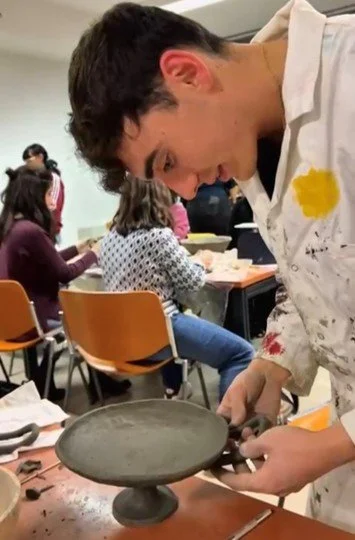
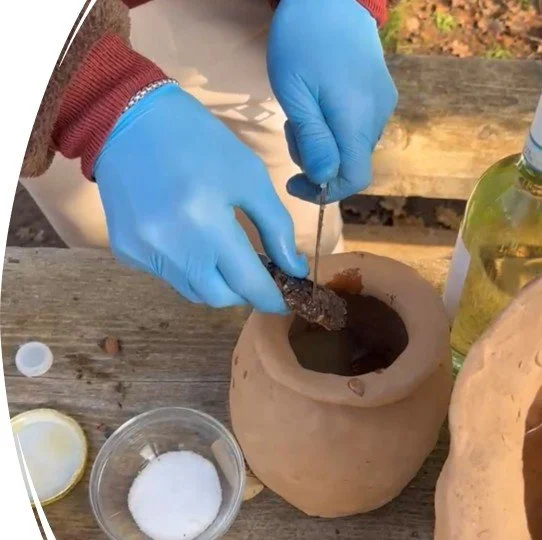
After studying the literary references to the ancient recipe and how it was prepared, we planned our experiment, aiming to recreate the taste of this unique beverage. First, we created the ceramic vessels for preparing and drinking Kykeon: a krater and a kylix (the latter beautifully crafted by Giordano). While these aren't perfect replicas, this experience helped us understand the complexity of the work carried out by Greek artisans. We attempted to replicate, as faithfully as possible and without any painted decoration, two Attic ceramic forms, respecting their dimensions as closely as possible. After modeling, the ceramics were fired in the kiln, and (sadly) they only partially survived this process: the kylix suffered a fracture at the bottom, while the krater lost a handle and part of its base. Nevertheless, our experiment continued, aiming to understand the taste and appearance of the Kykeon. The mixture was prepared in Pomezia, at the Prehistoric Village of Monte d'Oro, where we were able to prepare the Kykeon using an open-air fireplace. Using two-thirds of water and a third of wine, mixed with honey, pine resin, bay leaves, and grated goat cheese, the drink's flavor was pleasant but the taste was watered down: this is due to the fact that the wine drunk by the ancient Greeks had a much higher alcohol content than the wine we drink today (it was a sort of must), and therefore needed to be watered down to avoid being too strong. For this reason, given the alcohol content of the wine we used, we made a second preparation, this time using only one third of water, and this time the result was much more pleasant, allowing us to savor a flavor closer to that experienced by the Greeks. We were also surprised by how the goat cheese wasn't disgusting when mixed with everything else, but rather pleasant, making us realize that the taste of the ancients wasn't so far from our own, once we've tasted it.
The results of our experiment were encouraging: we felt like we were living the flavors and aromas experienced by the Greek elite, and this sensation was greatly appreciated by those who tried the Kykeon.
BIBLIOGRAPHY
· Delatte, A. (1956). Le cycéon, breauvage rituel des mystères d'Eleusis, in L'Antiquité Classique, 25-2
· González Wagner, C. (1984). Psicoactivos, misticismo y religión en el mundo antiguo.
· Papakonstantinou, Z. (2009). Wine and Wine Drinking in the Homeric World, in L'Antiquité Classique, 78
· Perrine, D. M., Ruck, C. A., Webster, P. (2000). Mixing the Kykeon, in ELEUSIS: Journal of Psychoactive Plants and Compounds, 4
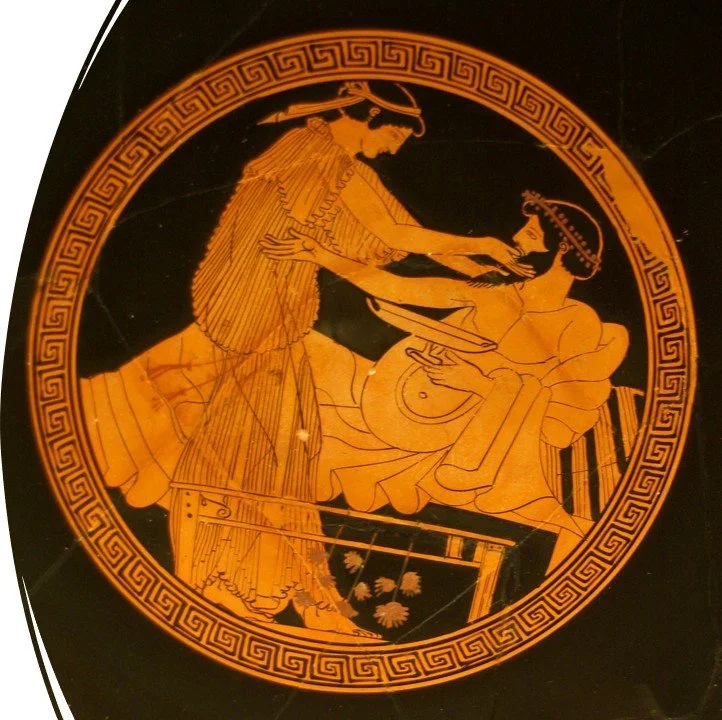
Cover picture: Depiction of the interior tondo of an Attic red-figure kylix with symposium scene.