
The cooking of Preroman food
How did our ancestors nourish themselves without the coziness of modern comforts? Nowadays we can just hop to the supermarket, grab a quick premade meal and call it a day, but in ancient times things were far from easy. Imagine being a villager in preroman Italy, your existence depending mostly on the weather: on a good year you would get an abundant crop, on a slightly wetter or drier one, your harvest would be scarce and insufficient to sustain your family or your community; moreover most of your animals would fall ill and your cattle would be decimated.
That didn’t stop the human desire to experiment with food, considering also the great cultural value that a meal has always contained: a sacrifice for the gods, a banquet to celebrate, a pouring on the ground for those who were no longer with us, were (and are, obviously taking account of all the differences in time, space and cultures) fundamental parts of the day to day life of those who came centuries before us.
But what were the ways of cooking the food that were adopted by the inhabitants of the Italian peninsula roughly in the first millennium B.C.? And what were the plants that were mostly consumed?
That’s where we step in the game: during the practical parts of the lecture of this year’s experimental archeology course, we were asked to reproduce a cooking vessel of our choice, and try to cook an ancient dish following the ancient recipes that we could gather or relaying on the archaeometric analysis that were conducted on some sites, indicating what foods were consumed in certain vessels, and also what was found outside, in the dumping areas. I choose to work on a site that was familiar for me, Civita Castellana (VT), on the Vignale hill, one of the location that were occupied by the ancient city of Falerii, one of the centers of the Faliscan population, situated on the “Etruscan” side of the river Tiber, but bearing a culture and a language that was similar to the one of their “cousins”, the Latins, on the other side.
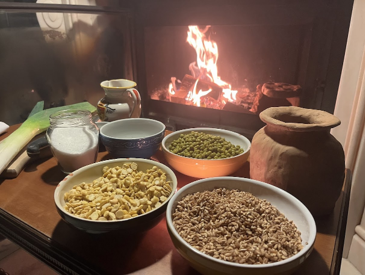
This past year paleobotanic analysis were conducted on the site by the Sapienza Università di Roma team, and they revealed the presence of some ancient remains of spelt, fava beans and peas, which sparkled the idea I decided to go through with: I would cook an ancient soup with those ingredients.
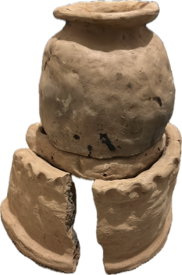
For more information on the matter, we searched and found an article by Alessandra Coen, that treated the evidence of the consume of spelt in preroman Italy. We also needed our vessel: I decided to try and create a cooking stand inspired by a type found in central Italy in the first millennium B.C. and an olla to go with it; moreover I realized also a perforated plate to put over the cooking stand, to try and see which way of cooking was more convenient in terms of efficiency and time.
The first phases of the process went on pretty easily, I used pure clay mixed with hay and fragments of gravel to assemble the cooking stand; unfortunately it was too thick, and despite the three weeks of drying it underwent, it exploded in the kiln, producing 3 different pieces, 2 of which were used in the final experimentation. I didn’t have much luck with the perforated plate either, since that broke in two pieces during the drying process. The olla remained intact and was used as I had anticipated.
The soup was realized according to a recipe handed down to us by Apicio, an ancient roman culinary expert who provided a cookbook; even though the cookbook can be dated to the first century A.D. and was redacted in the late antiquity we can still found recipes that were used in the Etruscan and preroman times, since at that point they were part of the Italian peninsula traditions. We mustn’t forget also that the romans were not some type of random invaders who came from some other part of the world: they had the same food choice as any other population in central Italy in the first millennium B.C., and consequently they probably (end certainly, according to Pliny in the regard of the “pulsus”) had some types of similar tradition and recipes as their neighbors, similar to how nowadays some Italian regions share the tripe as a traditional food.
I acquired all the ingredients that I needed: spelt, fava beans, peas, leek, dill, salt and pepper, mixed it all in the olla, then I put it over the cooking stand in the fireplace, where we had lit a small fire beforehand. Since the cooking stand was damaged, I had to figure out a way to use it anyway: I simply separated the two remaining parts to create a wider circumference, to create stability, then I put the perforated plate over it. So even if the three braces I had originally planned as the olla sustainers were no longer in the right place, the thing worked anyway.
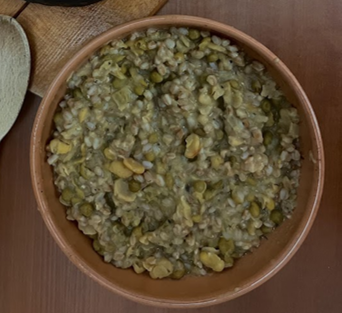
The soup took a long time to cook, since we had to move around the fire a little bit to maintain it in the right spot, but in the end the soup came out creamy and with a grilled chestnut scent. I also figured that one olla of those dimensions could contain roughly one portion of soup, so if you had to cook for a family, you would’ve needed a bigger container.
In the end this experimentation showed us that the preroman food wasn’t so much different from what we eat nowadays, only realized and eaten in a different time and culture: through what we can recognize as ancient tradition we can try to rebuilt a healthier relationship with our environment and our food, to preserve both the culture and the planet.
Bibliography
Bellelli 2012: V. Bellelli, Particolarità d’uso della ceramica comune etrusca, in MEFRA, 124-2, 2012, pp. 377-392.
Bellelli-Benelli 2010: V. Bellelli, E. Benelli, Un settore “specializzato” del lessico etrusco: una messa a punto sui nomi di vasi, in Mediterranea, 6, pp. 139-152.
Biella et al. 2022: M.C. Biella, M.A. De Lucia Brolli, O. Di Trapani, M. Fortunato, L.M. Michetti, P. Poleggi, A. Pola, G. Valenza, Falerii (Civita Castellana, VT): gli scavi nell’abitato 1992-2005. Le indagini nel giardino di Palazzo Feroldi Antonisi De Rosa (1999), in Bollettino di Archeologia Online 13, 2022/2, 2022, pp. 97–195.
Coen 2021: A. Coen, Il consumo del farro e dei cereali in ambiente etrusco-italico e nel Piceno in età preromana, in StUrbin 87, 2021, pp. 87–107.
Foddai 2006: E. Foddai Fornelli fittili da Fidenae, in BCom 107, pp. 7-30.
Franchetti 2022: G. Franchetti, A tavola con gli etruschi, Roma 2022.
L’alimentazione nel mondo antico 1987: L’alimentazione nel mondo antico. Gli Etruschi, Roma 1987.
Martinelli 2019: M. Martinelli, Cultua del cibo tra Etruria e Mediterraneo, Roma 2019.
Scheffer 1982: C. Scheffer, Acquarossa II.2. The Cooking Stands. Part 2, Stoccolma 1982.